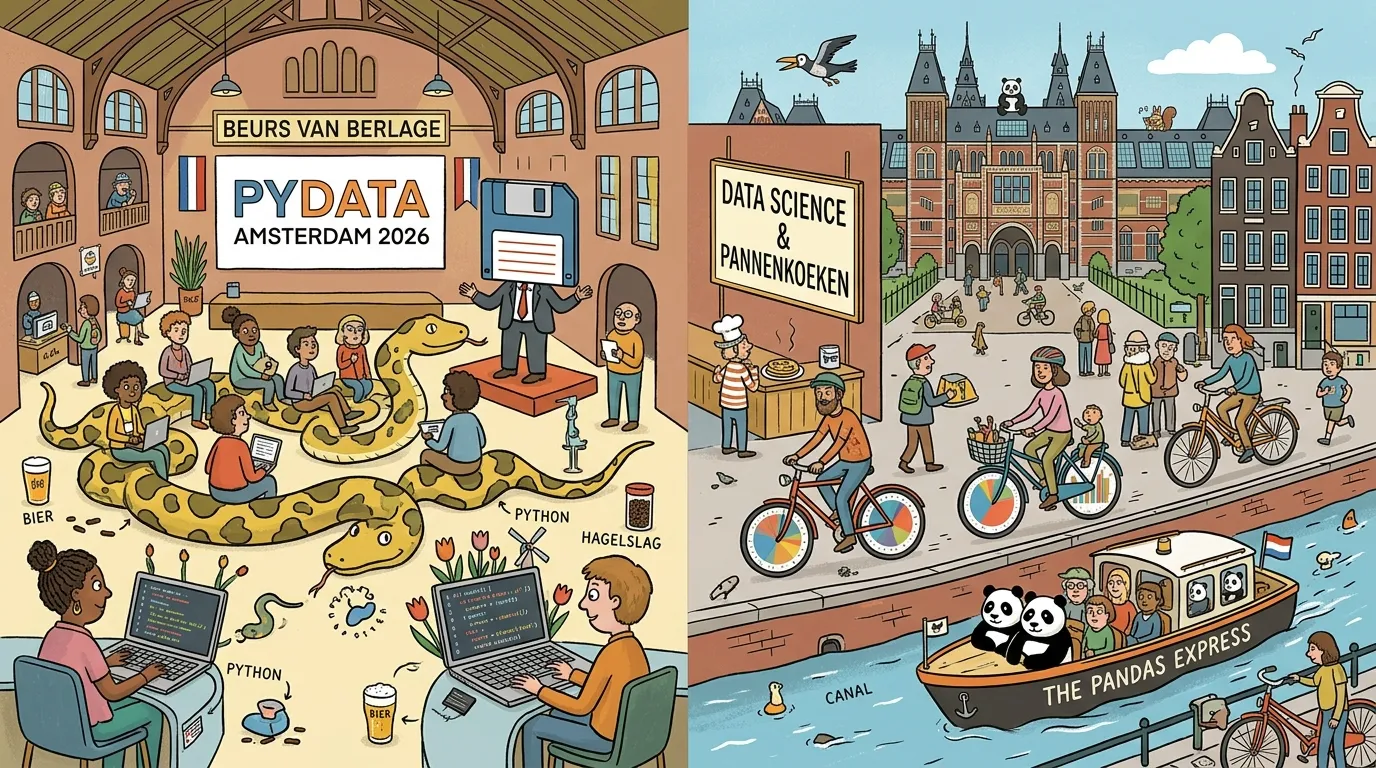
I attended PyData Amsterdam 2026 on
September 10 and 11 at NDSM Loods. There were many talks about LLMs, often
showing different ways to solve the same problems.
Five themes stood out to me: context limits, evaluation, DuckDB, semantic
layers, and agents. The common lesson was simple: let the LLM choose what to
do, but let deterministic code do the work whenever possible.
Everyone fights the context window
LLMs can only hold so much text at once. Several talks dealt with this limit,
but used different workarounds:
- retrieve only the relevant text with RAG;
- summarize the source material first;
- split the work across several agents;
- process separate chunks and combine their answers.
A Databricks talk covered tasks with more than 10 million tokens. The proposed
approach combined three techniques:
- Map-reduce: run the LLM on each chunk, then combine the partial answers.
- Hierarchical summarization: create summaries, then summaries of those
summaries.
- Multi-agent routing: send each sub-question to a specialist agent.
The reported quality increased from roughly 70% with plain RAG to roughly 90%
with the combined approach. These percentages come from my conference notes;
I do not have the exact metric used in the talk.
Source: Azamat Omuraliev, talk page.
The 2% problem
Mars presented the other side of multi-step agent systems: small errors
compound.
If one step is 96.5% reliable, the chance of completing 20 dependent steps
without an error is about 50%:
A system can therefore look very accurate at the step level and still be
unreliable as a whole. Even 98% accuracy per step is not enough for long,
strict workflows.
Mars addressed this with heavy human verification. Their stack included a
knowledge graph, a data lake, agents, process-mining tools, and Gemini. The
important part was not the exact stack. It was the refusal to treat every AI
answer as trustworthy.
Source: Patrick van Balkom, AI You Can Bet Your Business On.
Right words, wrong meaning
Mars also found that documentation could use the right words while still
capturing the wrong meaning. In one example, two experts disagreed about the
logic behind "carton thickness".
Instead of allowing the AI to choose one interpretation silently, the team
made both versions explicit. They also recorded experts explaining their work
out loud, converted the recordings to text, and used the result as input for
the knowledge graph.
The useful workflow was:
Record an expert -> speech-to-text -> reviewed ground truth
The deeper lesson is that retrieval cannot fix incorrect source material. If
the source is ambiguous, the ambiguity must be resolved or represented.
The LLM should not compute the route
TomTom showed a clean separation of responsibilities:
Driver request -> LLM chooses a tool -> TomTom API computes the route
The LLM understands the request and selects the right operation. It does not
calculate the route itself. If a request contains two possible places called
"King Street", the assistant asks a question instead of guessing.
The team uses pytest-bdd together with an LLM judge and reports coverage
of roughly 98% of the assistant's behaviour. They can also send the same
request to two model providers and use the first answer that returns. A small
model produces an immediate acknowledgement while the main request runs.
This is more expensive per request, but good evaluation makes it possible to
change providers or move to a cheaper model when the measured quality remains
acceptable.
Source: Tara Farzami, When should an AI Agent say "I Don't Know"?.
An evaluation score is evidence, not a fact
Jodie Burchell from JetBrains applied ideas from psychometrics to LLM
evaluation. Psychometrics measures traits that cannot be observed directly,
such as intelligence or anxiety. A test score is evidence about such a trait,
not the trait itself.
The same caution applies to LLM evaluations. If a score rises from 72% to
81% after a prompt or chunking change, the system may have improved. But the
score alone does not prove it.
She proposed four useful gate checks.
1. What exactly did I prove?
Evaluation results are usually narrower than the claims made about them.
"The model handles customer support better" is too broad if the test only
checks information extraction.
A claim such as the following is less exciting, but supportable:
The model extracts dates and account IDs from this set of messy emails
correctly 85% of the time.
Name the task, the data, and the success condition.
2. What else changed the score?
LLM evaluations can be sensitive to token order, whitespace, prompt wording,
system instructions, and judge bias. An LLM judge may also prefer long,
friendly answers even when they are not more correct.
Try harmless prompt variations. Replace double quotes with single quotes. Add
whitespace. Reword the request without changing its meaning. If the score
moves by 10%, the test may be measuring formatting rather than capability.
3. What else should also improve?
Do not trust one score or one LLM judge. Check a second, unrelated signal:
- users accept more answers;
- fewer users complain;
- generated code passes more real tests;
- the returned data matches a known correct result.
When two unrelated measurements improve, the change is more likely to be
real.
4. What did my test not check?
A test only supports conclusions about the examples and conditions it covers.
A chatbot scoring 90% on 100 tidy English questions tells us nothing about
adversarial users, Dutch questions, angry customers, or latency under load.
State these gaps next to the score. Passing the test does not mean the system
works for every real user.
DuckDB remains a conference favourite
DuckDB appeared throughout the conference. In August 2026, AWS acquired
DuckLabs, the company behind DuckDB. The core DuckDB engine remains available
under the MIT licence and is governed through the DuckDB Foundation.
Another visible trend is distributing datasets as .duckdb files instead
of CSV or JSON. A DuckDB file can contain several related tables, preserve
data types, and be queried directly.
Further reading: AWS and DuckLabs
and The Register's report.
Semantic layers were the gem of the conference
A semantic layer is not a framework or file format. It is a concept: define
business meaning once, in code, and let every consumer use the same
definition.
It can describe:
- what a claim is;
- what "total loss" means;
- how tables connect;
- which dimensions can be used for grouping or filtering;
- which measures and metrics are available.
BI tools, notebooks, applications, and LLMs then ask for metrics by name.
They do not rebuild the business logic independently.
The pattern is the same as in the TomTom example:
The LLM chooses what to ask for. Code decides how to compute it.
Grounding AI agents in dbt manifests
Ricardo Angel Granados López showed a documentation pipeline grounded in dbt
manifests:
Extract -> draft with citations -> validate mechanically -> human sign-off
The dbt manifest is the source of truth. An agent must cite its claims. Claims
that cannot be checked against the manifest are flagged instead of trusted.
Source: onto-datamodel companion repository.
Testing a semantic layer against plain SQL
The dbt benchmark uses a fictional ACME Insurance dataset containing policies,
claims, premiums, agents, and related data. Its questions and gold answers
come from a 2023 data.world paper.
The benchmark supports three strategies:
- sql
- The LLM receives raw table definitions. It writes the joins, calculations,
and complete SQL query itself.
- semantic_layer
- The LLM receives a menu of metric and dimension names. It writes a query
that selects those names.
- mcp
- The LLM uses tools to fetch the menu, then makes the same kind of selection
through tool calls.
The published result dataset I reviewed contained sql and
semantic_layer rows, but no MCP rows.
Sources: dbt-labs/dbt-llm-sl-bench and the benchmark dashboard.
Four semantic-layer building blocks
The semantic layer in the benchmark has four main parts:
- Entities define keys and how tables connect. Together, they form the
join graph.
- Dimensions define what can be used to group or filter results.
- Measures define basic aggregations such as sums, counts, and averages.
- Metrics define named business numbers, including filters and formulas.
For example, total loss can be defined once:
- name: total_loss_amount
  type: derived
  type_params:
    expr: loss_payment_amount + loss_reserve_amount
If claim has a foreign catastrophe key and catastrophe defines the
matching primary key, MetricFlow knows how to join them. Neither the user nor
the LLM has to write the join manually.
The LLM only picks names
Before asking the model a question, the benchmark lists the available metrics
and dimensions and places that menu in the prompt. The prompt also includes a
small syntax example and guardrails.
The model can select names or return CANNOT_ANSWER. A query can look like
this:
select * from {{ semantic_layer.query(
  metrics=['total_loss_amount'],
  group_by=['claim__catastrophe_identifier']) }}
The dbt Semantic Layer Gateway turns this into warehouse SQL, executes it,
and returns Arrow data.
Scoring without an LLM judge
The benchmark does not ask another model whether an answer looks correct. It
runs the gold query and the generated query, then compares their returned
data.
Gold SQL result =? Generated query result
Each model runs every question five times. This is a strong example of using
a second, independent measurement: correctness is checked mechanically against
the expected data.
The result: 52% versus 93%
Across the original insurance tables, the reported correct-answer rate was:
- 52% without a semantic layer;
- 93% with a semantic layer.
The questions and AI models were the same. The difference was responsibility.
Without the semantic layer, the model wrote SQL, joins, and calculations. With
it, the model selected named business concepts and deterministic code produced
the SQL.
The benchmark used eight insurance questions, five runs per question, and
several models. When dbt added three helper tables, plain SQL improved to 82%
while the semantic-layer approach remained around 92%. Cleaner data helped,
but encoding the business meaning still produced the strongest overall
result. One small model, GPT-5.6 Luna, performed worse with the semantic layer,
so the benefit was not universal in every individual run.
The results can be inspected on the dbt LLM semantic-layer benchmark.
What I brought back
The talks covered different systems, but their lessons fit together:
- Do not expect a larger context window to solve every large-document task.
- Measure reliability at the full workflow level, not just per agent step.
- Make ambiguity explicit. Retrieval is not enough when the source itself is
unclear.
- Let LLMs interpret requests and choose tools. Let tested code perform exact
calculations and operations.
- Treat evaluation scores as noisy evidence. State exactly what was tested and
what was not.
- Prefer mechanical checks over an LLM judge when a real result can be
executed and compared.
- Put business definitions in a semantic layer instead of asking every model,
query, or dashboard to reconstruct them.
The semantic-layer benchmark made the last point especially clear. The largest
improvement did not come from asking the model to reason harder. It came from
giving the model a smaller, safer job.
Originally published as GitHub Gist #6b8395ae748e90a5fec407600cc63567